
Madagascan Sunset Moth
Chrysiridia rhipheus
High-resolution Macro Photography by Brett Kuzyk
High-resolution interactive composite image
Chrysiridia rhipheus
The Madagascan Sunset Moth is a day-flying species endemic to Madagascar and a member of the family Uraniidae. Although commonly mistaken for a butterfly due to its vivid coloration and diurnal behavior, it is taxonomically a moth.
Its iridescent greens, blues, and copper tones are not produced by pigment, but by microscopic scale structures on the wings. These layered nanostructures manipulate light through interference and diffraction, creating structural coloration that shifts with angle and illumination.
The species feeds on toxic plants in the genus Omphalea, making it distasteful to predators — a defense that allows it to display its bright coloration openly during daylight hours.
Considered one of the most visually striking Lepidoptera in the world, Chrysiridia rhipheus has become an icon of structural color in nature.
Click to explore the full-resolution composite by zooming into the image.

About the Photographer
Brett Kuzyk is a macro photographer whose practice centers on the detailed study of insects, plants, and small objects.
Through fine-art, high-resolution macro photography, he focuses on clarity, colour, and quality. His work respects each subject’s texture and natural heritage, resulting in images intended to remain visually compelling and materially relevant for generations to come.
Wing Scale Architecture
At higher magnification, the iridescent coloration of Chrysiridia rhipheus resolves into overlapping microscopic wing scales. Each scale is composed of layered chitin structures arranged in repeating ridges and lamellae.
Rather than containing pigment, these scales manipulate light through physical structure. The stacked layers act as microscopic interference surfaces, selectively reflecting specific wavelengths depending on viewing angle and illumination.
The repeating ribbed architecture visible here functions as a biological diffraction system. As light strikes the surface, it is scattered and recombined, producing the shifting greens, blues, and copper tones characteristic of the species.
This structural coloration is stable over time, as it is embedded in the physical architecture of the scale rather than dependent on chemical dyes.
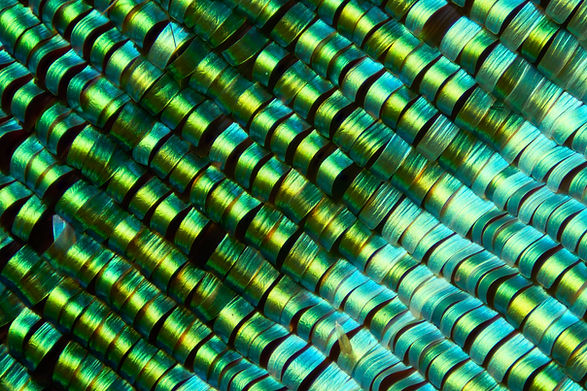
Sony A7IV, Custom lens tube system, 10x Magnification.
The Process
This image was produced from 565 exposures captured at 1:1 magnification using a Phase One IQ3 100MP digital back mounted on a motorized focusing rail.
The specimen was photographed in twelve sections, six documenting the dorsal surface and six documenting the ventral surface, with each section containing between 40 and 80 exposures.
The specimen was independently sourced through Thorne’s Insects and prepared for imaging, including rehydration, spreading and pinning before image capture.
The resulting stacks were assembled into a unified composite while maintaining scale consistency across the specimen.
Developed over several months of research, testing, and refinement, the final image measures 21,000 × 12,000 pixels, preserving fine structural detail throughout.

Exhibition
This work is currently on display as part of “Ommatidia” at the TAP Centre for Creativity in downtown London, Ontario. The work will be viewable from February 6th to 28th, 2026.
“Ommatidia” was a collaborative exhibition between students from the Fanshawe College Advanced Photography program and students from Western University’s Department of Visual Arts and SASAH (School for Advanced Studies in the Arts & Humanities).
The exhibition explored the concept of ommatidia — the individual visual units that form the compound eyes of insects — as a metaphor for multiple ways of seeing. In biology, ommatidia enable insects to perceive the world through a wide and mosaic-like field of vision. Drawing from this structure, the exhibition presented a diverse body of photographic works reflecting varied subjects, materials, and visual methodologies.
Each work functioned as an individual visual unit within a larger collective framework, contributing to a broader conversation about perception, detail, and interpretation.
Participating organizations included:
-
TAP Centre for Creativity
-
Fanshawe College - Advanced Photography
-
Western University – Department of Visual Arts
-
Western University – SASAH
-
Satellite Project Space




Madagascan Sunset Moth (Chrysiridia rhipheus) (2026)
This body of work is created through the stitching of 565 high-resolution images into a single composite photograph. This process is formally known as focus stacking. Working at a 1:1 magnification ratio, Brett Kuzyk photographs the insect in small increments using a motorized rail that slowly moves the camera along the surface. The moth is photographed in twelve sections, including both the top and underside, before being digitally combined into one.
Kuzyk began this practice in September, transitioning from high-fashion photography into a body of work focused on what he describes as the hidden beauty of the world. Drawn to detail and texture, Kuzyk focuses on representing insects as physically accurate as possible. Insects are important in ecosystems across all climates, yet they are often overlooked or underappreciated. Printed at a large scale of 40 × 70 inches, this photograph showcases the Madagascan sunset moth’s outer anatomical details in its entirety.
— Maya Allison
Western University
Ommatidia Exhibition Catalogue, 2026
With gratitude to the collaborators and institutions
who supported the Ommatidia exhibition.
Availability
Limited large-format prints available.
Institutional inquiries and exhibition requests welcome.
Contact: b_kuzyk@fanshaweonline.ca

© 2026 Brett Kuzyk